
March 18, 2024
Chromadeck vs Correx vs ACM: Which Sign Material Should You Choose?
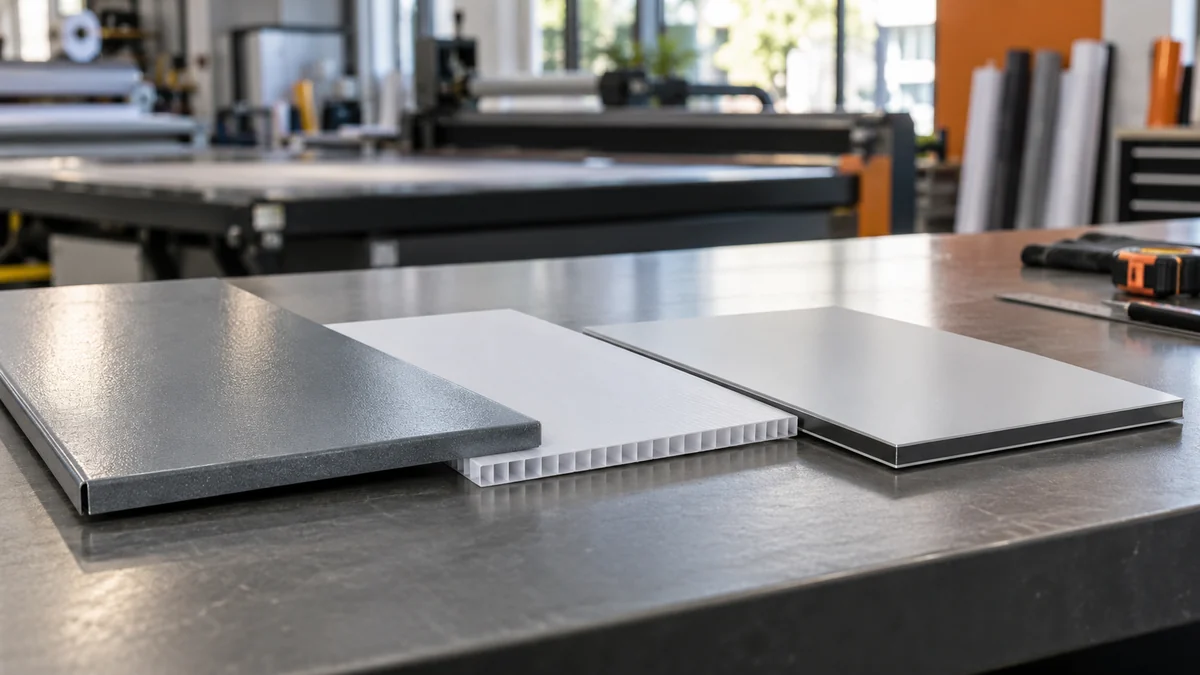
Choosing a sign material is easier when you start with the job the sign must do. A short-term directional board for an event has different requirements from a permanent business sign on an exposed wall. Chromadeck, Correx and aluminium composite material (ACM) can all carry a full-colour printed design, but they differ significantly in weight, rigidity, handling and the environments they suit.
Chromadeck, Correx and ACM at a glance
| Consideration | Chromadeck | Correx | ACM |
|---|---|---|---|
| Durability | Durable coated-steel panel for ongoing business and site signage | Best for temporary and short-term campaigns | Durable composite panel suited to repeated handling and premium displays |
| Rigidity | Rigid metal sheet; larger panels may benefit from a frame | Lightweight and less rigid, with a fluted core | Very rigid for its relatively low weight |
| Typical use | Business, shop-front, safety, property and construction signs | Event directions, campaigns, temporary notices and bulk signs | Premium displays, branded panels and event boards |
| Indoor/outdoor suitability | Commonly selected for outdoor signage | Indoor or temporary outdoor use, subject to fixing and exposure | Indoor and outdoor applications when the complete print and installation are specified correctly |
| Relative cost | Mid-range; framing and edging add cost | Usually the most economical | Usually higher than Correx and positioned as a premium rigid option |
| Transport and shipping | Heavier; large or framed signs need careful packing | Light and convenient to move in quantity | Lighter than solid metal but corners and printed faces still need protection |
These are practical comparisons, not promises of a fixed service life. Sun, wind, moisture, installation, maintenance and the print finish all influence how a completed sign performs.
When Chromadeck is the practical choice
Chromadeck is coated steel, giving the sign a firm metal face and useful rigidity. It is a strong fit for long-term business identification, parking instructions, construction boards, safety information and directional signs. Ellesi’s current Chromadeck sign range uses 0.6 mm Chromadeck with full-colour printing and offers standard and custom formats.
A flat sheet works well when it can be fixed to a suitable continuous wall or structure. Larger panels, exposed locations or installations that need extra support may call for a rear steel frame. Ellesi also offers a framed construction with aluminium angle edging around the perimeter. Those additions increase weight and cost, but they create a more supported finished sign.
Chromadeck is not automatically the answer for every outdoor project. A very large sign still needs a sound installation plan, and a metal panel is less convenient than Correx when dozens of temporary boards must be transported between locations.
Where Correx makes sense
Correx is a fluted plastic sheet. The internal channels make it light, economical and easy to handle. It is useful for property campaigns, temporary promotions, event directions, site notices and other applications where low weight and quantity matter more than a premium solid-panel feel.
Ellesi’s printed Correx boards include compact A2 and A1 options produced on 3 mm material, as well as related Correx products. The light construction helps when several signs must be carried, distributed or installed for a short campaign.
The trade-off is rigidity. A Correx panel can flex, especially as its size increases or if it is not supported properly. Wind and unsuitable fixings can stress a lightweight board. For temporary outdoor use, plan the fixing method and placement rather than assuming that the material alone makes the installation secure.
When ACM earns its place
ACM sandwiches a core between thin aluminium skins. It provides a smooth, rigid panel with a premium feel while remaining easier to handle than a similarly sized solid metal plate. It is often chosen for high-quality display boards, event signage and applications where a flat presentation and repeated handling are important.
Ellesi currently offers 3 mm ACM on selected event products, including its printed wedding welcome and seating-chart boards. You can also browse the Aluminium and ACM Signs category for the current range.
Although ACM is rigid, it is not immune to poor handling. Corners can be damaged in transit, printed faces can be scratched and a large panel still needs appropriate support. Protect it during transport and match the mounting method to the panel size and location.
A simple way to decide
- Choose Chromadeck for a durable metal business, safety or property sign, particularly when a framed construction is useful.
- Choose Correx for lightweight, economical and temporary signage that must be moved or ordered in quantity.
- Choose ACM for a premium rigid panel where presentation, flatness and repeated handling are priorities.
Then check four project details: finished size, expected exposure, installation method and transport. A well-chosen material can still fail if the sign is too large for its support, placed where the message cannot be read or packed without protecting its edges.
Frequently asked questions
Is Correx suitable outdoors?
It can be used for temporary outdoor signage when the fixing method, wind exposure and duration are appropriate. It is not the closest substitute for a rigid long-term metal sign.
Does every Chromadeck sign need a steel frame?
No. A flat panel may be appropriate for fixing to a suitable continuous surface. Size, location and mounting determine whether additional support is sensible.
Is ACM the same as solid aluminium?
No. ACM is a composite panel with thin aluminium skins and a central core. Its construction gives it a different weight, rigidity and edge profile from a solid aluminium sheet.
Need help comparing options for a real installation? Browse Ellesi’s Signs and Boards, or request a custom quote with the size, location, mounting surface and expected exposure.