
May 28, 2026
Wedding Welcome Signs and Seating Charts: Materials, Sizes and Display Options
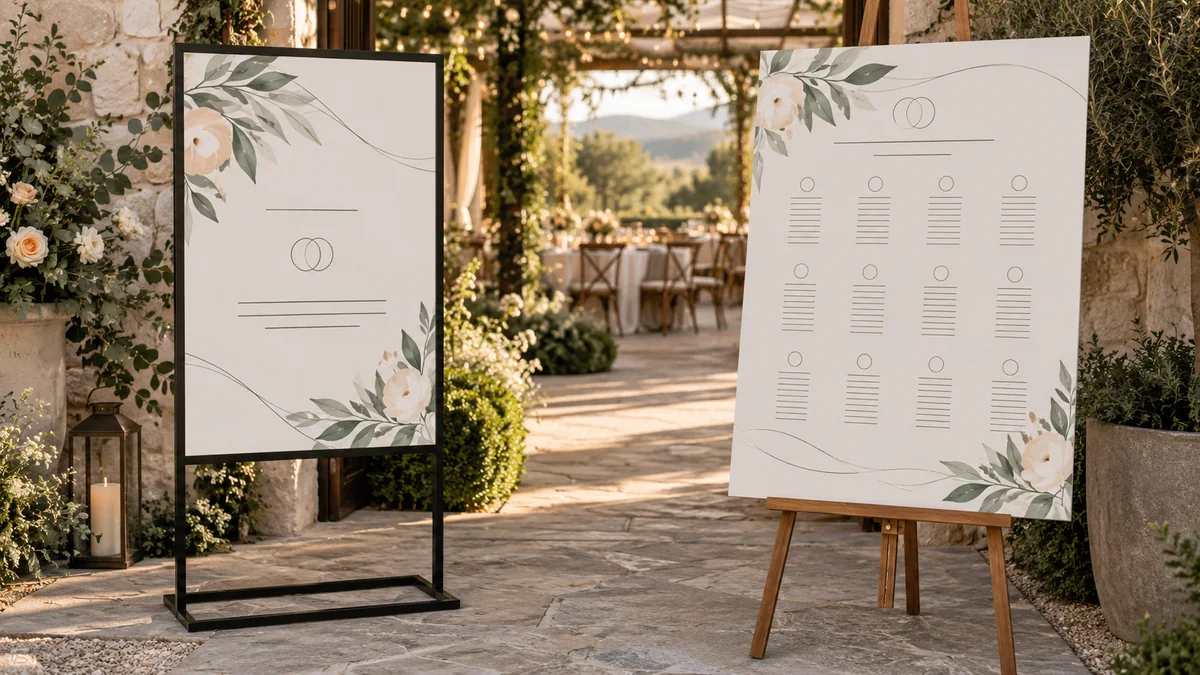
Wedding welcome signs and seating charts do different jobs. A welcome board sets the tone at the entrance with a short message, while a seating chart must organise many names clearly enough for guests to find their tables without creating a queue. Material, size and stand choice should follow from those roles, the venue and the way the signs will be transported.
Welcome sign or seating chart?
A welcome sign usually contains the couple’s names, wedding date and a short greeting. Because the wording is brief, the design can use generous spacing, larger lettering and decorative details. It works well near the ceremony or reception entrance where guests pause and photographs may be taken.
A seating chart is an information display. It needs a logical order, clear table headings and enough space for every guest name. Alphabetical layouts help people find themselves quickly at larger events; table-by-table layouts show the groupings more directly. Whichever structure you choose, avoid decorative type for small names.
Ellesi has dedicated products for Wedding Welcome Signs and Wedding Seating Charts, so the different artwork and design-service requirements can be configured separately.
Current board material options
5 mm Correx
Ellesi’s current wedding-sign products use 5 mm Correx as the lightweight option. Its fluted construction makes a large board easier to carry and practical for a once-off event. It is a useful choice when transport weight and budget matter, provided the board is supported properly and handled with care.
8 mm Foamboard
Foamboard provides a thicker, smooth presentation surface for carefully handled indoor displays. The current wedding products use 8 mm Foamboard. Keep it dry and protect faces and corners during transport because pressure or moisture can damage a foam-core board.
3 mm ACM
ACM is the premium rigid option in the current range. Its aluminium-composite construction gives the board a flat, substantial presentation and makes it suitable for repeated handling. It weighs more and costs more than the lightweight choices, but it is a strong option for a formal entrance piece or a sign intended for reuse.
Acrylic can look elegant in a controlled installation, but it is not the primary recommendation here. Large acrylic sheets need careful packing and are more vulnerable to cracking or shipping damage. Opaque Correx, Foamboard and ACM provide practical choices for couriered wedding signage and work with a range of stands.
Choose a size for the content and venue
Ellesi’s current wedding welcome and seating-chart products offer 60 × 90 cm, 80 × 120 cm, 90 × 150 cm, 120 × 120 cm and 120 × 180 cm. Custom sizes can be quoted when the available space or guest list needs another format.
For a welcome sign, consider the entrance width and the stand. A 60 × 90 cm portrait board can suit an intimate venue, while a larger board creates more presence in a broad foyer or outdoor entrance. Do not enlarge the board only to add more words; a short message usually makes the strongest welcome.
For a seating chart, start with the guest list. A compact design may work for a smaller celebration, but many tables and long names need more area. Test the smallest guest names at the expected reading distance. It is better to choose a larger board or a simpler layout than to make names uncomfortably small.
Match the board to a reliable stand
The printed sign and the stand are separate products in Ellesi’s current setup. That keeps each item’s price, stock and delivery details clear. Browse Display Stands while selecting the board so the size, weight and style are compatible.
Common presentation routes include:
- a classic wooden easel for a warm, traditional venue;
- a metal easel for a minimal or contemporary look;
- a weighted rear-support stand where a cleaner front view is preferred; and
- a metal floor frame that holds a large board within a defined structure.
Place the stand on a firm, level surface and keep guest traffic in mind. A seating chart should not block a doorway or force a queue across the venue entrance. Outdoor setups need a weather contingency; even a rigid board can become unstable in wind if the stand is not appropriate.
Artwork upload and design assistance
Both current wedding-sign products allow you to upload print-ready artwork, send artwork after ordering or select Ellesi’s design service. The live product pages state the scope and price of the design option, including the initial proof and included minor revision. Review those details on the selected product before ordering.
Supply names and table information as editable text where possible, not only as a photograph of a handwritten list. Use one consistent spelling source and appoint one person to approve changes. Confirm surnames, accents, table numbers and the final wedding date before signing off the proof.
Keep the board proportions in mind when choosing a template. Artwork designed for a square 120 × 120 cm chart will not simply stretch into a portrait 90 × 150 cm board without changing spacing and line breaks.
Plan the complete setup
- Confirm the venue location and whether the sign will be indoors or temporarily outdoors.
- Finalise the welcome wording or seating list.
- Choose a material based on presentation, handling and budget.
- Select a size that gives the content enough space.
- Choose a compatible stand and confirm its colour.
- Approve the artwork only after checking every name and number.
- Plan transport, setup time and protective packaging.
Ready to create the entrance display? Explore Wedding Signs, compare Wedding Seating Charts and add a suitable stand from the current range.