
November 6, 2025
Correx, Foamboard or ACM for Event and Display Signage?
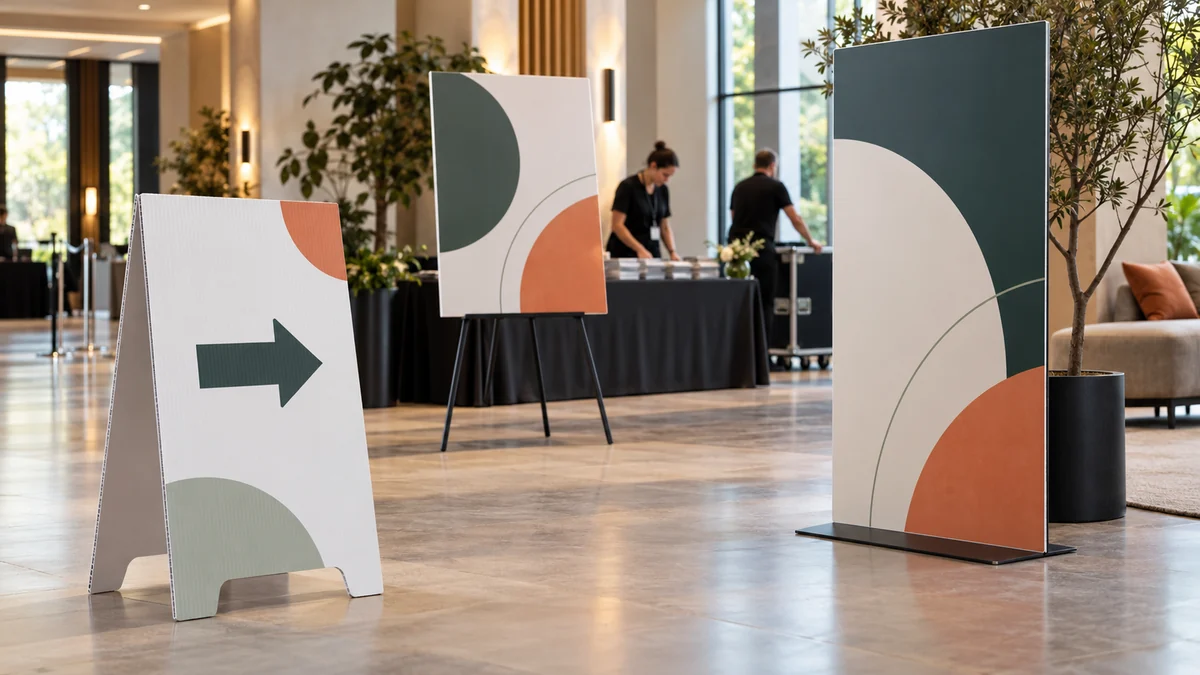
Event signage has to look good at the venue, but it also has to survive packing, transport, setup and removal. Correx, Foamboard and aluminium composite material (ACM) can all produce effective display boards. The best choice depends on how formal the event is, whether the sign will be indoors, how often it will be handled and what stand or fixing will support it.
There is no single best board for every event requirement.
Material comparison for event signs
| Factor | Correx | Foamboard | ACM |
|---|---|---|---|
| Weight | Very light | Light | Moderate, but lighter than a solid metal plate |
| Rigidity | Flexible compared with solid boards | Smooth and reasonably stiff for indoor display | High rigidity and good flatness |
| Durability | Practical for short campaigns and event use | Needs careful handling; edges and faces can mark | Best suited to repeated handling of the three |
| Environment | Indoor and temporary outdoor use, subject to exposure and fixing | Primarily dry indoor use | Indoor or outdoor use when print, edges and installation are specified appropriately |
| Transport | Easy to carry in quantity | Light, but protect from crushing and moisture | Rigid and manageable; protect corners and printed face |
| Typical event role | Directions, schedules and temporary notices | Presentation boards and polished indoor displays | Premium welcomes, branded displays and signs reused across events |
“Foamboard” can describe different products in the market. Ellesi’s current plain Foamboard is a lightweight foam-core board with smooth outer faces, offered in 3 mm and 5 mm. Selected printed event products currently use 8 mm Foamboard. It is not the same as solid expanded PVC sheet, often called Foamex.
Choose Correx for light, temporary signage
Correx has a fluted plastic structure that keeps weight and cost down. It is useful when an event needs several arrows, parking notices, room labels or sponsor boards that must be carried and positioned quickly. Printed Correx boards are also convenient for campaigns that move between locations.
Because the material is light, larger panels need suitable support. An easel, rear brace or continuous fixing surface should hold the board without allowing it to bend or catch wind. Correx can be used for temporary outdoor directions, but weather, duration and fixing conditions matter.
Use it when practicality and quantity are more important than a thick premium edge. It is often the best value for behind-the-scenes wayfinding even when a more rigid material is used for the main entrance sign.
Choose Foamboard for controlled indoor displays
Foamboard combines a light foam core with smooth faces. The clean surface and thicker appearance suit presentations, schedules, menus, mounted photographs and formal display boards in dry indoor venues. Its low weight makes setup easy.
The trade-off is handling. Corners can crush and surfaces can be dented if boards are stacked without protection. Keep Foamboard dry, carry large panels with two hands and use a stand that supports the board evenly. It is better for a controlled foyer or conference room than an exposed outdoor entrance.
The Plain Foamboard product shows Ellesi’s terminology for the unprinted material. For a printed event product, use the thickness and finish listed on that specific product page rather than assuming it matches the plain-board range.
Choose ACM for a premium rigid board
ACM uses thin aluminium skins around a central core. It remains flat, presents clean edges and tolerates repeated handling better than lightweight display board. That makes it a strong choice for branded entrance pieces, premium welcome signs, seating charts and displays intended for more than one event.
It costs more and weighs more than Correx or Foamboard, so it is not always necessary for every arrow and notice. Use it where the sign’s visual presence and rigidity justify the extra investment. Protect its corners and printed face in transit, and match the stand to the board dimensions.
Use more than one material strategically
An event does not need every sign produced on the same substrate. A practical system might use:
- ACM for the main branded welcome board;
- Foamboard for indoor schedules, menus or presentation pieces;
- Correx for parking, loading and directional signs; and
- a fabric or PVC banner where a large flexible backdrop is required.
This approach puts the premium material where guests notice it most while keeping temporary operational signage easy to transport. Browse Event Signs and Display Stands together so the selected board and support are compatible.
Questions to answer before ordering
- Will the sign be indoors, outdoors or moved between both?
- Is it needed once or intended for repeated use?
- How far must guests read it from?
- Will it travel flat in a car, by courier or with an event crew?
- Which stand, wall or frame will support the finished size?
- Does the artwork use the same proportions as the selected board?
Need help matching material, size and support? Explore Ellesi’s event signage range, or request a quote for a coordinated set of custom boards.